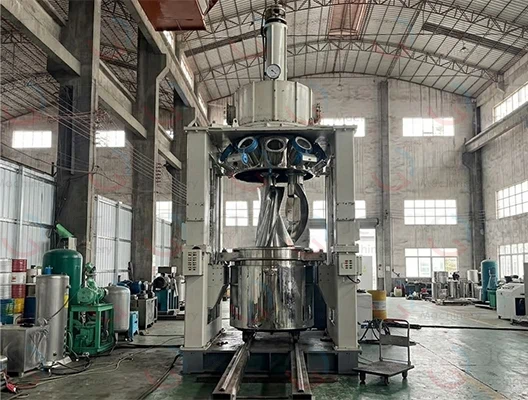
Our functional composite materials vertical kneader is designed for the mixing, kneading and dispersion of resins, polymers, and various functional fillers. Engineered for high-viscosity, high-solids-content, and low-flowability composite materials, the equipment utilizes continuous extrusion, shearing, and folding actions to thoroughly blend the components and enhance material uniformity.
Depending on production process requirements, the system can be configured with a vacuum system, a heating/cooling jacket, variable-frequency speed control, and a hydraulic lifting system to meet the production needs for various functional composite materials.
Functional Composite Materials Vertical Kneader Equipment Parameters
| Model |
Full Volume /L |
Useful Volume /L |
Min Volume /L |
Power /KW |
Pericentric Blade Speed /rpm |
Telecentric Blade Speed /rpm |
Revolution Speed /rpm |
Clearance /MM |
Vacuum Abs Pressure /kPa |
| VK-10 |
16.9 |
12 |
2 |
5.5 |
0~25 |
0~50 |
0~6 |
3±0.5 |
<1.5 |
| VK-100 |
135 |
100 |
15 |
22 |
0~25 |
0~50 |
0~6 |
4.5±0.5 |
<1.5 |
| VK-500 |
500 |
350 |
60 |
37 |
0~22.5 |
0~45 |
0~6 |
5.5±0.5 |
<1.5 |
| VK-1000 |
1000 |
600 |
120 |
45 |
0~22.5 |
0~45 |
0~6 |
6±1 |
<1.5 |
| VK-2000 |
2000 |
1200 |
200 |
55 |
0~20 |
0~40 |
0~6 |
7±1 |
<1.5 |
| VK-3000 |
3000 |
1800 |
300 |
75 |
0~20 |
0~40 |
0~5 |
8±1 |
<1.5 |
| VK-5000 |
5000 |
3000 |
500 |
110 |
0~18 |
0~36 |
0~5 |
9±1 |
<1.5 |
Main Applications of Functional Composite Materials Vertical Kneader
- Thermally conductive composites
- Electrically conductive composites
- Resin-based composites
- Polymer composites
- Functional filler composites
- Electronic packaging composites
- Insulating materials
- Other high-viscosite functional materials
Vertical Kneader Suited fot the Specialized Design of Function Composite Materials
1. Specialized kneading paddle design
The vertical kneading paddle continuously subjects high-viscosity materials to squeezing, shearing, folding, and turnover actions; it is better suited than standard mixing paddles for processing composite materials composed of resin and large quantities of functional fillers.
2. Small clearance between the mixing blades and the vessel wall
Properly controlling the clearance between the mixing blades and the inner wall of the vessel reduces material residue and enhances material shearing and turnover, thereby helping to improve mixing uniformity.
3. High-torque drive system
When functional composite materials are compounded with significant amoutns of thermally conductive powders, electrically conductive powders, mineral fillers and the like, their viscosity can increase substantially. Consequently, the equipment typically requires a high-torque, low-speed drive system to ensure stable operation even with high-viscosity materials.
4. Vacuum-sealed design
Certain functional composite materials—particularly those used for electronic packaging, thermal conduction, and insulation—are sensitive to air bubbles. Vertical kneaders can utilize a sealed mixing chamber equipped with a vacuum system to perform vacuum degassing during the mixing process.
5. Heating/cooling jacket
Mechanical heat is generated during the kneading process, while some resin systems are sensitive to temperature. The equipment can be equipped with a heating or cooling jacket to maintain the material within the appropriate processing temperature range.
6. Staged feeding design
For systems comprising resin and a large amount of functional powder, a staged feeding approach can be adopted depending on the process. For instance, adding the resin and a portion of the additives first, followed by the gradual addition of functional fillers, helps improve filler wetting and dispersion.
7. Variable frequency speed control
The rotational speed can be adjusted according to different production stages. For example, low speed is used for initial mixing, high speed for enhanced dispersion, and reduced speed for vacuum degassing, allowing a single piece of equipment to perform multiple process steps.
8. Inner surface design to prevent material contamination
For composite materials sensitive to impurities—such as those used in electronics, thermal conduction, or insulation applications—appropriate inner surface treatments and materials can be selected based on customer requirements to minimize the risk of material contamination while facilitating cleaning.
For functional composite materials—such as those offering thermal conductivity, electrical conductivity, or insulation properties—we can customize the functional composite materials vertical kneader's mixing blades, drive system, vacuu, system, and temperature control system based on the resin system, filler type, filler ratio, viscosity, and production process.
Tel: +86-181 3837 3963 (Whatsapp, Wechat)
Email: verticalkneader@outlook.com


 Inquire (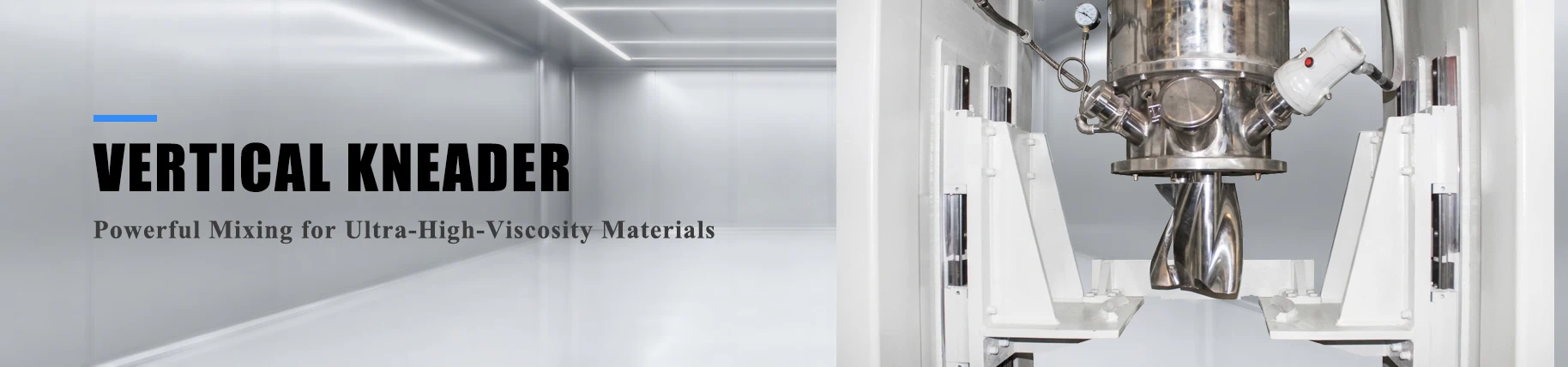
 HOME
HOME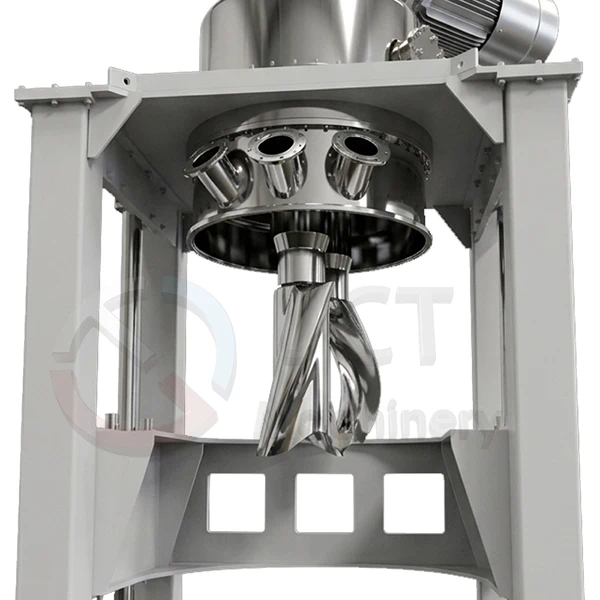


 Related Suggestion
 Aug 10,2026
 Tel
Tel
 Email
Email
 Address