

 Inquire (
 HOME
HOMEVertical Kneader For Thermal Conductive Materials: JCT's Answer To Ultra-high Viscosity TIM Mixing
 Sep 24,2026

 JCT
JCT
Thermal interface materials have moved from a supporting component to a deciding factor in product performance. As electric vehicles, AI computing and data-centre liquid cooling, and 5G equipment push power densities higher, the thermal conductive materials carrying that heat away must be more heavily filled, more viscous and more uniform than ever before.
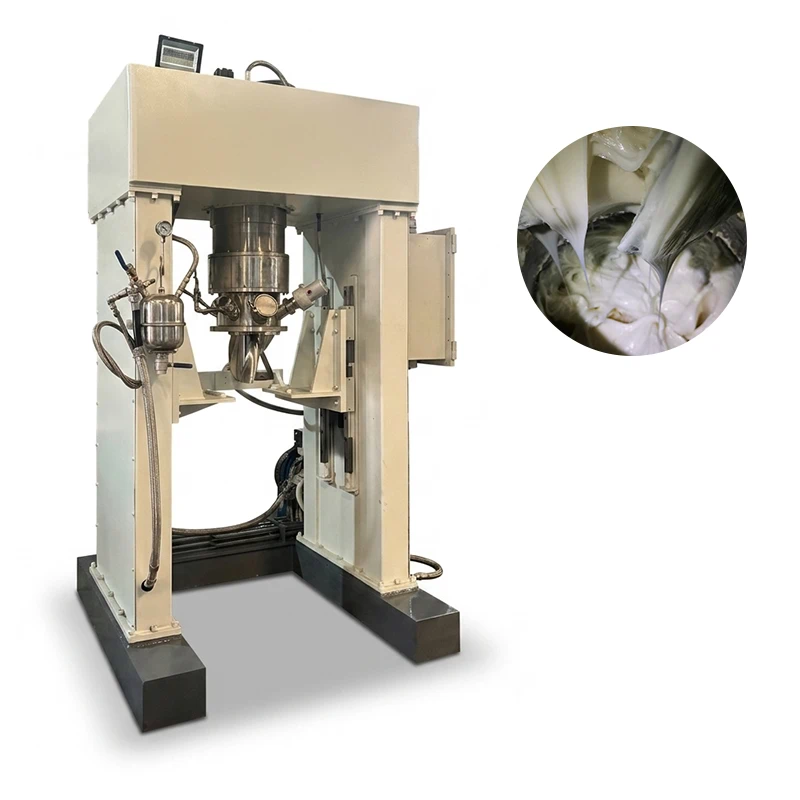
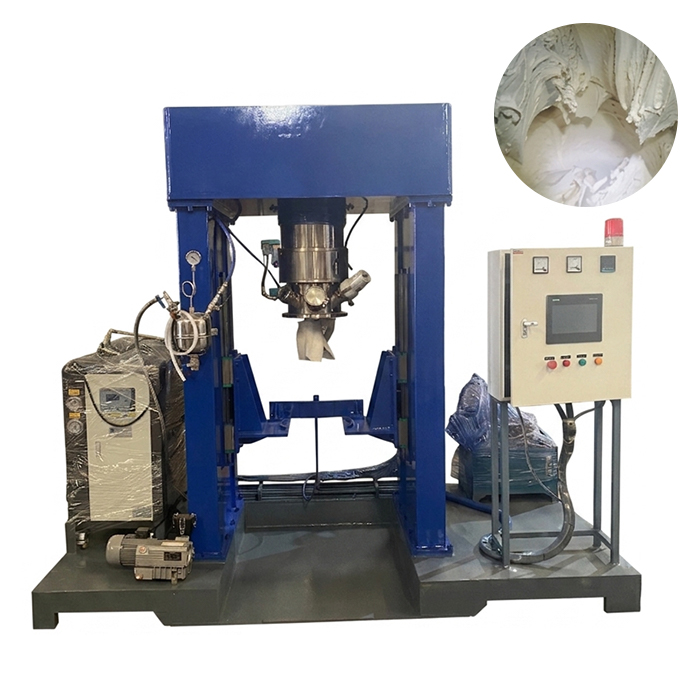
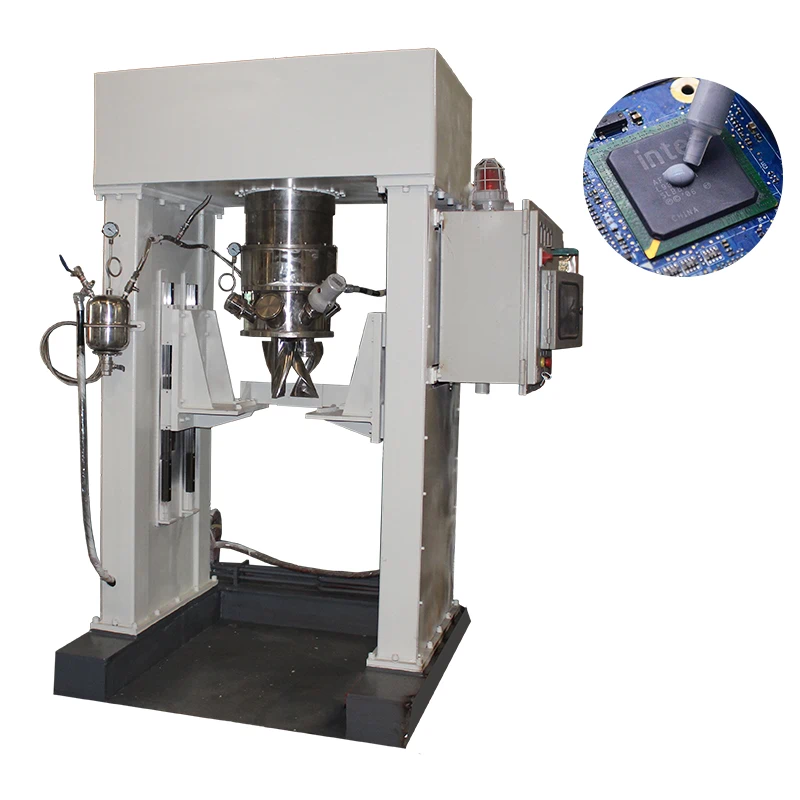
That shift puts unusual pressure on mixing equipment. Thermal grease is typically built from silicone oil, thermally conductive fillers such as alumina, boron nitride and zinc oxide, plus functional additives—a combination defined by very high viscosity, a large proportion of powder, and a strong tendency to agglomerate. JCT Machinery's vertical kneader for thermal conductive materials was developed specifically for this class of material, handling viscosities up to 20,000,000 CP and high-filler composite formulations.
1. Where conventional mixers fall short
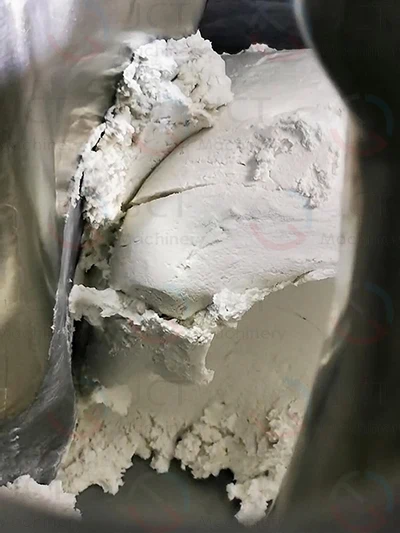
Uniformly dispersing dense inorganic powder inside high-viscosity silicone oil is difficult to achieve with conventional mixing equipment. Powder clumps survive the mixing cycle, air is entrained, and the finished product loses the very property it was formulated for: consistent thermal conductivity.
Sigma mxiers introduce a second, subtler risk—contact. Where shaft seals and bearings sit below or beside the material, wear particles can enter the batch. For high-end thermal interface materials, even trace metallic contamination is unacceptable.
2. How vertical kneader works
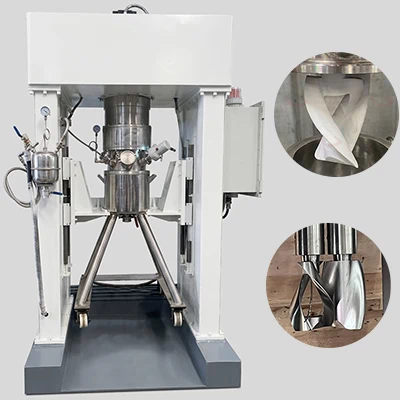
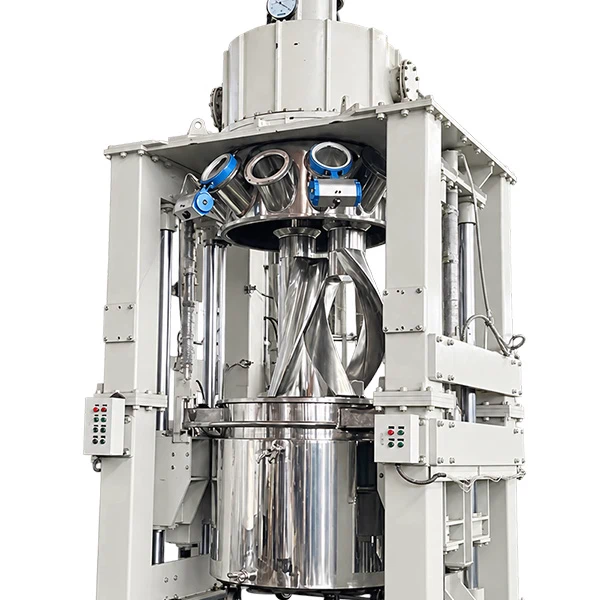
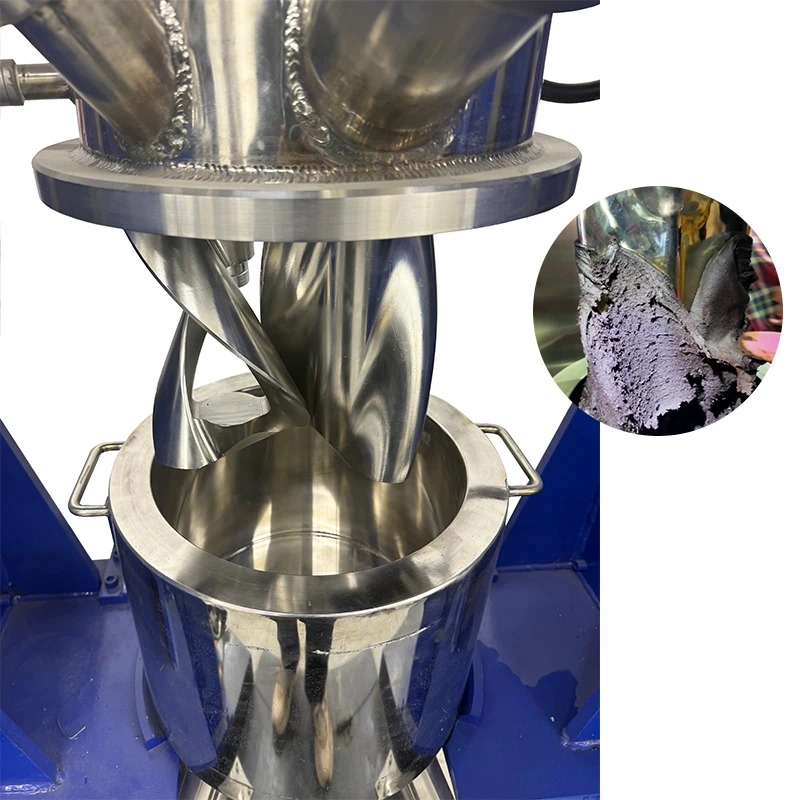
The machine is a vertical kneader fitted with two spiral kneading blades. One set rotates planetarily around the other, and the two sets continuously adhere to and peel away from each other. Highly viscous material is subjected to intense shearing, compressing and frictional forces inside the kneading space, producing thorough, uniform mixing in a very short time.
Because the working principle is planetary and the blades reach the full vessel volume, there are no dead angles—the same reason this design can replace horizontal kneaders and other mixing equipment outright.
3. Four engineering answers to the thermal material problem
Zero metal contamination. The main shaft seal and bearings are suspended entirely above the kneading vessel. With no mechanical shaft seals or rotating contact surfaces at the bottom or sides of the vessel, the material never meets the seal during kneading—a decisive advantage for high-purity thermal interface materials.
Powerful kneading plus vacuum degassing. The impeller holds a precise 2–3 mm gap to the vessel wall, kneading high-viscosity silicone oil together with dense inorganic powder the way a baker works dough—eliminating powder clumping. A built-in deep vacuum system reaching −0.098 MPa then crushes and removes air bubbles during the process, so the finished grease is dense, levels well, and delivers the thermal conductivity it was designed for.
Modular multi-bucket operation. One main unit can serve multiple material buckets. Once kneading is finished, the bucket is pushed away or moved along a track straight to the downstream hydraulic press and precision filling machine, while the main unit immediately takes on a second, pre-loaded bucket. Production continues without interruption, and capacity scales with the number of vessels rather than with additional main units.
Tungsten carbide wear protection. Thermally conductive powders are inherently abrasive. Impellers and inner walls can be finished with tungsten carbide (WC) thermal spraying at hardness up to HRC 65+, or with ceramic surface treatment, extending equipment service life by more than three times.
4. Specifications at a glance
-
Operating mode: planetary, no dead angle
-
Viscosity range: 800,000 CP – 20,000,000 CP
-
Temperature range: 0–220 °C
-
Vacuum range: ≥−0.1MPa
-
Models: experimental, pilot-scale and production configurations, designed according to actual requirements
5. One platform, several high-viscosity applications
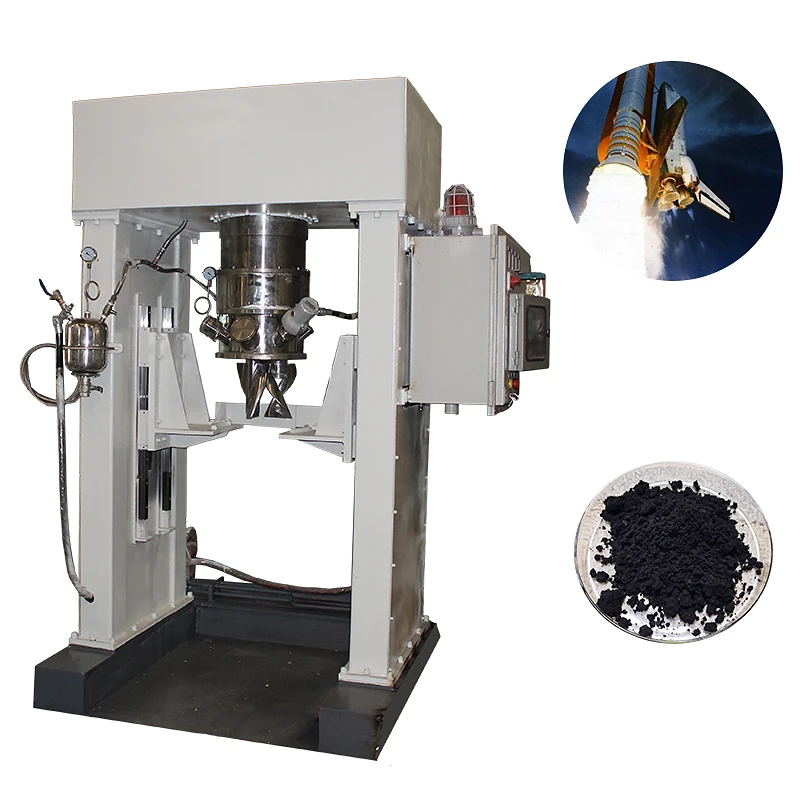
The same vertical kneading platform is used for thermally conductive silicone grease, dental resin, propellants and carbon fibre composites—applications that share one common requirement: powerful, contamination-free kneading of materials that resist conventional mixing.
6. Talk to us about your formulation
Model selection depends on the material and the process rather than on a catalogue number. JCT provides operating-condition assessment, selection advice and sample testing, and manufactures key components in-house to keep impeller and vessel precision under direct control.
Model selection depends on the material and the process rather than on a catalogue number. JCT provides operating-condition assessment, selection advice and sample testing, and manufactures key components in-house to keep impeller and vessel precision under direct control.
Tel: +86-181 3837 3963 (Whatsapp, Wechat)
Email: verticalkneader@outlook.com
 What Are The Characteristics Of Vertical Kneader Blades?
 You May Also Like

 Tel
Tel
 Email
Email
 Address
Room 506, Building 3, Block B1, Hantian Technology City, Shenhai Road, Nanhai District, Foshan, Guangdong, China

JCT
 Whatsapp